
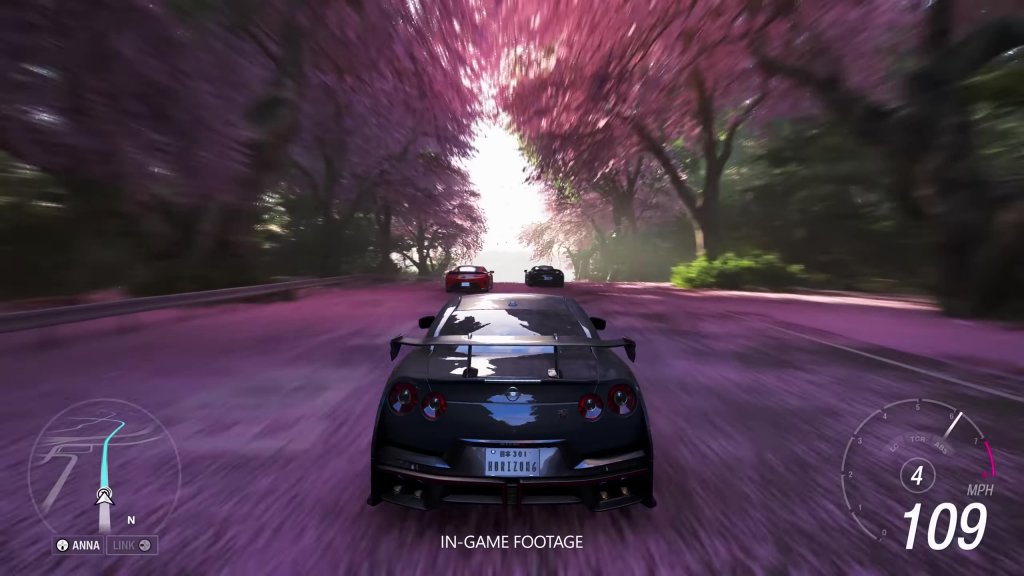
The opening session of Forza Horizon 6 immediately sets the tone: structured chaos, creative car builds, and navigation-heavy street racing across a dense Tokyo-inspired map. The format blends garage creativity (widebody A-Class builds) with improvisational racing formats that remove traditional HUD advantages like maps and waypoints.
A recurring theme across the session is adaptability—drivers are forced to rely on road intuition, car familiarity, and split-second decision-making rather than optimized racing lines or meta builds.
Event Structure Overview
The first challenge series consists of multiple competitive layers:
| Stage | Event Type | Key Constraint |
| 1 | Widebody Build Challenge | A-Class conversion required |
| 2 | Free Roam Street Race | No map / no waypoint |
| 3 | Quarter Mile Drag Race | Straight-line tuning test |
| 4 | Circuit Race | Tire strategy & handling |
| 5 | Time Attack | Individual lap performance |
| 6 | Drift Zone | Angle + control scoring |
| 7 | Long Jump (Danger Sign) | Momentum-based scoring |
| 8 | Top Speed Test (improvised) | Straight-line max velocity |
Each event contributes to a cumulative leaderboard that determines the overall winner.
Widebody A-Class Build Challenge
Players begin by selecting a widebody car and upgrading it to A-Class. The meta immediately diverges:
- Some players go lightweight and agile (Civic-style builds)
- Others commit to heavy “luxury JDM” interpretations
- One player inadvertently creates an overpowered or unintended class build (“broke the game” moment)
Build Philosophy Split
| Style | Example Direction | Performance Trait |
| Lightweight tuner | Civic / RX-7 style | High corner agility |
| Luxury JDM build | Crown-style builds | Stability, heavier handling |
| Experimental builds | Mixed upgrades | Unpredictable performance |
A key observation: A-Class tuning variance is extremely high in FH6, making early-game balance heavily skill-dependent.
Tokyo Free Roam Race (No Map Challenge)
This is the first true skill check: players must race from Daikoku to a space center quarter-mile strip without using the map or waypoints.
Outcome Summary
| Player Behavior | Result |
| Highway routing | Stable but slower |
| City cutting | High risk / high reward |
| Random navigation | Frequent disorientation |
| Shortcut discovery | Race-defining advantage |
A notable moment was a successful “cut” through Tokyo streets that dramatically changed positioning, proving FH6 rewards environmental knowledge over pure speed.
Drag Race (Quarter Mile Test)
The drag event exposes drivetrain imbalance and tuning issues:
- FWD cars suffer heavy wheelspin
- AWD cars dominate consistency
- Launch control becomes critical
Drag Race Snapshot
| Position | Vehicle Type | Performance Note |
| 1 | AWD builds | Clean acceleration |
| Mid | Balanced RWD | Variable traction |
| Last | High-power FWD | Severe wheelspin |
This stage reinforced that FH6’s early meta heavily favors traction systems over raw horsepower.
Circuit Race: Handling vs Power
The circuit segment introduces a technical track emphasizing braking zones and corner memory.
Key findings:
- Sports tires outperform rally tires on paved circuits
- AWD stability helps exit corners
- Front-wheel drive struggles under sustained acceleration
Tire Performance Comparison
| Tire Type | Grip | Cornering | Race Suitability |
| Sport | High | Balanced | Optimal baseline |
| Semi-slick | Very high | Strong | Competitive meta |
| Rally | Medium | Loose on asphalt | Poor for circuit |
A standout insight: drivers using rally setups experienced unexpected understeer and exit instability.
Time Attack Leaderboard
Time attack results highlight tuning gaps and skill differences more clearly than any other mode.
Recorded Lap Times
| Player | Best Lap | Rank |
| DJ | 1:00+ range | 1st |
| Nathan | ~0:59 | 2nd |
| Beaker | ~1:03 | 3rd |
| Others | 1:05+ | Lower tier |
The gap illustrates how FH6 rewards optimized braking points more than raw acceleration.
Drift Zone Performance
Drift scoring emphasizes angle consistency and sustained slide control.
Drift Scoring Results
| Player | Score Tier | Notes |
| Top performers | High 190+ | Controlled drift chains |
| Mid group | 180–195 | Inconsistent transitions |
| Low tier | <180 | Grip loss or early exits |
A critical mechanic observation: AWD drift builds are viable but require aggressive handbrake management to maintain angle.
Long Jump (Danger Sign Test)
A physics-heavy event where momentum retention becomes decisive.
| Placement | Outcome |
| 1st | Longest jump achieved via heavy AWD build |
| Mid | Mixed results due to inconsistent launch |
| Last | Low airtime due to poor speed retention |
Rally tires unexpectedly underperformed on the jump surface, indicating surface-specific grip modeling in FH6.
Top Speed Test (Impromptu Event)
A late-stage addition, the top speed test highlights straight-line tuning dominance.
- Minimal braking required
- Gear ratio optimization becomes critical
- Aero drag differences become highly visible
This event confirmed that some builds excel only in specific performance domains, reinforcing FH6’s “specialization meta.”
Overall Championship Standings
Final Point Distribution
| Player | Points |
| DJ | 11 |
| Jack | 5 |
| Beaker | 4 |
| Nathan | 4 |
| Kimmy | 1 |
| Gee | 1 |
DJ’s consistent podium finishes across nearly every event secured a decisive lead.
Economy & Progression Notes
Early-game progression in Forza Horizon 6 appears tightly linked to vehicle access, tuning flexibility, and upgrade progression.
Players repeatedly referenced progression bottlenecks and car availability differences. In practice, progression acceleration is often tied to in-game resources such as FH6 Credits, which influence how quickly competitive builds can be assembled and tested.
Some players also referenced the advantage of using Buy Forza Horizon 6 Credits strategies to bypass early grind limitations, particularly when experimenting with multiple build archetypes or tuning paths.
Key Takeaways from the First Challenge Set
- FH6 heavily rewards route knowledge over GPS dependence
- Build diversity creates extreme performance variance even within A-Class
- Tire and drivetrain choices matter more than raw horsepower early on
- Multiplayer stability is functional but still shows synchronization inconsistencies
- Event design strongly favors adaptable drivers over specialized ones
This opening session establishes FH6 as a hybrid of structured racing and improvisational street competition, where creativity and navigation matter almost as much as tuning optimization.